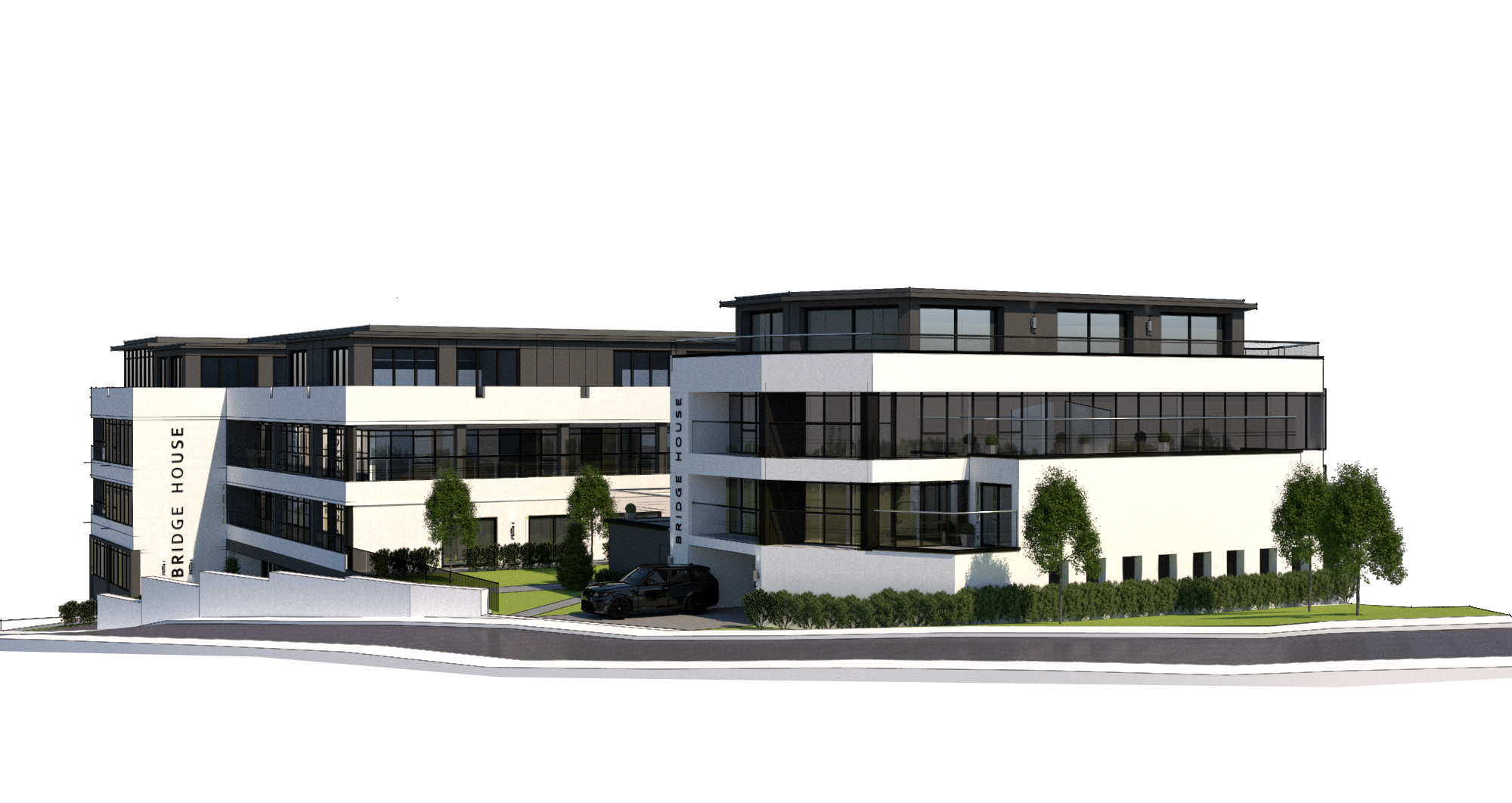
Office-to-residential conversion with Substantial New Build Element
The Bridge House project explored the transformation of an existing Brutalist concrete office building into high-quality residential accommodation, supported by a complementary new-build element. Commissioned as a detailed feasibility study, the proposals sought to unlock the site’s latent potential through adaptive reuse, while introducing a bold architectural identity appropriate to its prominent setting.
The design approach carefully balanced the robustness of the existing concrete structure with a refined new architectural language inspired by Art Deco principles. Strong horizontal emphasis, layered façades, and disciplined proportions were used to reinterpret the building for residential use, softening its original commercial character while retaining its inherent solidity and presence. The new-build element was conceived as a clear yet complementary addition, reinforcing the overall composition without competing with the retained structure.
Internally, the feasibility focused on delivering efficient, well-proportioned residential layouts that maximised daylight, outlook, and amenity, demonstrating the viability of converting the former office floorplates into desirable homes. The proposals considered access, servicing, and planning constraints from the outset, ensuring that the scheme was grounded in deliverability as well as architectural ambition.
Bridge House is a strong example of how early-stage feasibility and design thinking can drive meaningful regeneration. By combining adaptive reuse with confident new-build intervention, the project illustrates a strategic approach to repurposing underused commercial buildings, creating a clear pathway toward residential redevelopment rooted in both planning realism and architectural quality.
Want to Work with Us?
Contact